
Professionalization is often presented as a project of standards, ethics, and recognition. It is also a revenue model. The numbers suggest that if AISA adopts a professionalized membership structure, the financial value of each member could increase dramatically. What is now a modest annual fee base could become a far more lucrative and scalable source of recurring income.
Without professionalization, what is an AISA member worth?
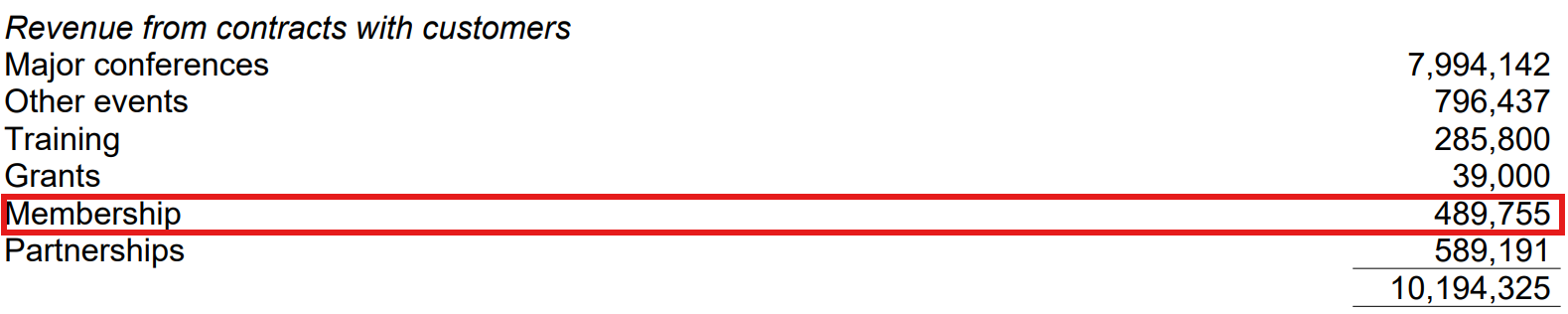
In 2025, AISA reported approximately 14,000 members and AUD 489,755 in membership revenue. (1, 2) This corresponds to roughly AUD 35 per member, per year.
With professionalization, what is an AISA member worth?
Even proponents of professionalization estimate that members may be charged between AUD 100 and AUD 350 annually once a scheme is introduced. (3) This is approximately 3x to 10x higher than the current level.
These estimates are modest because they are framed from the perspective of affordability rather than institutional cost.
The question is not just what members can afford, but what a credible institution would need to charge.
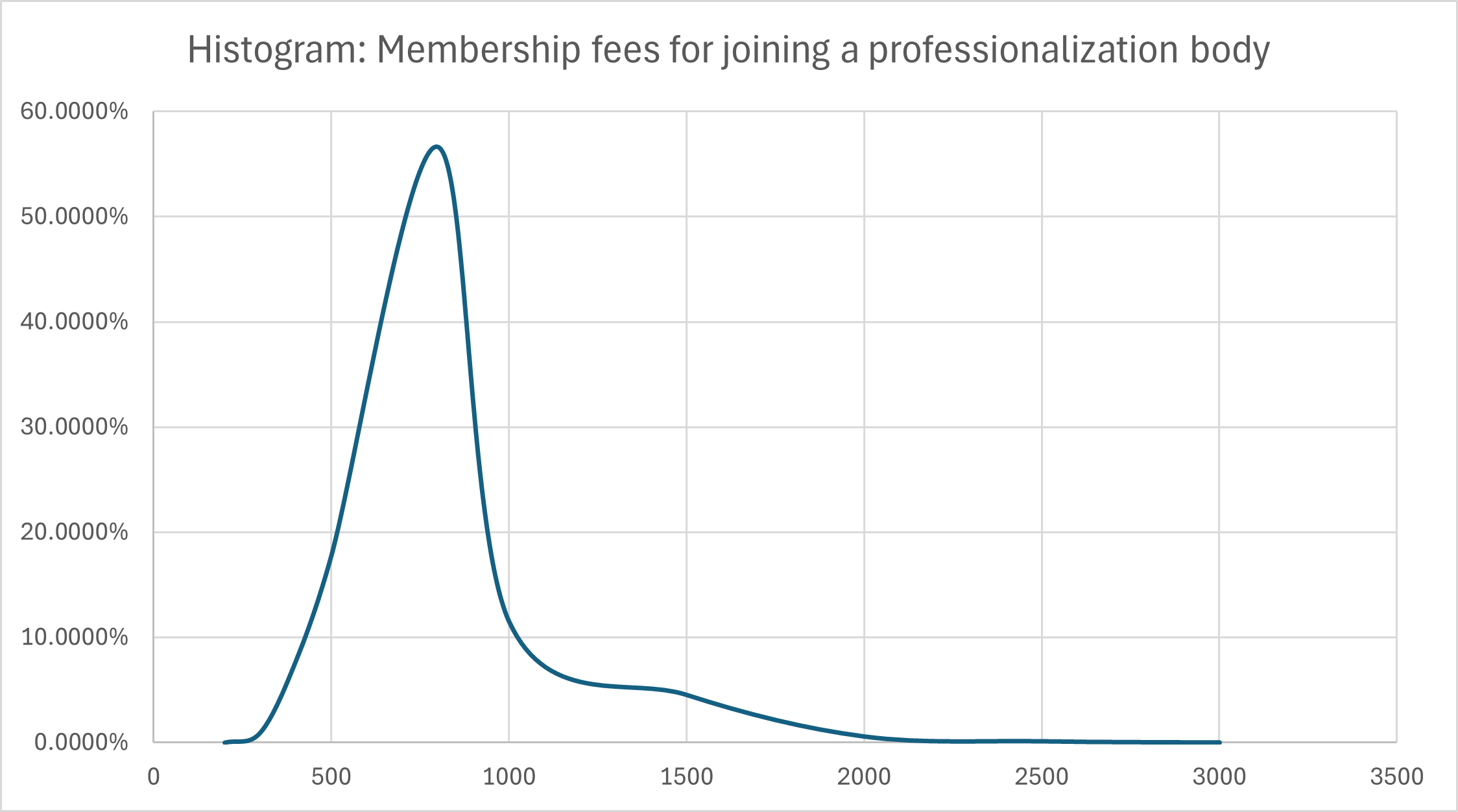
As it turns out, having an independent board, running audits, investigating complaints, and enforcing decisions is expensive. Based on Monte Carlo modelling, a credible body requires approximately AUD 3,000,000 to AUD 6,000,000 annually to operate with independence and enforcement capability. (4)
In 74% of simulations, the required average annual membership fee fell between AUD 500 and AUD 800 to cover operating costs. That is approximately 14x to 22x higher than the AUD 35 currently collected. (4)
With professionalization, what is the total AISA membership worth?
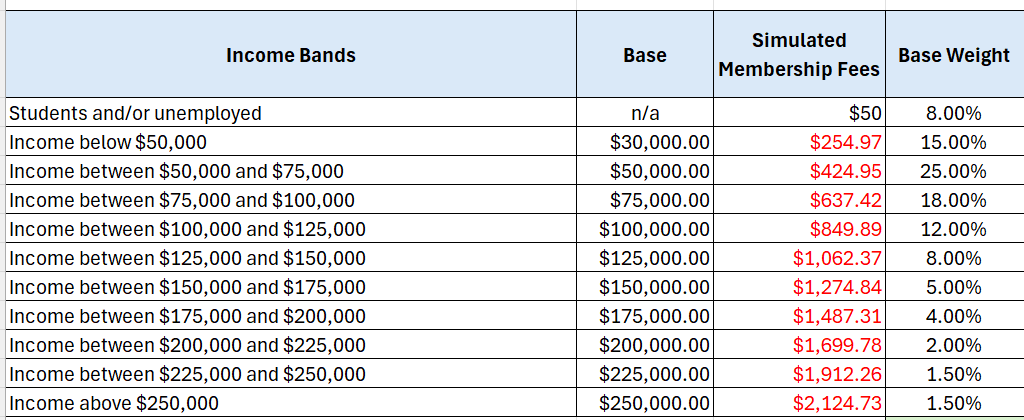
More sophisticated membership models go further by linking fees to salary, which increases revenue as member income rises. These models are presented as equitable, aligning contributions with members’ capacity to pay. They also make revenue scalable and optimizable. (5)
To test this on the entire AISA membership, I modelled salary-linked fees across AUD 25,000 income bands and simulated different fee-to-income ratios. (6)
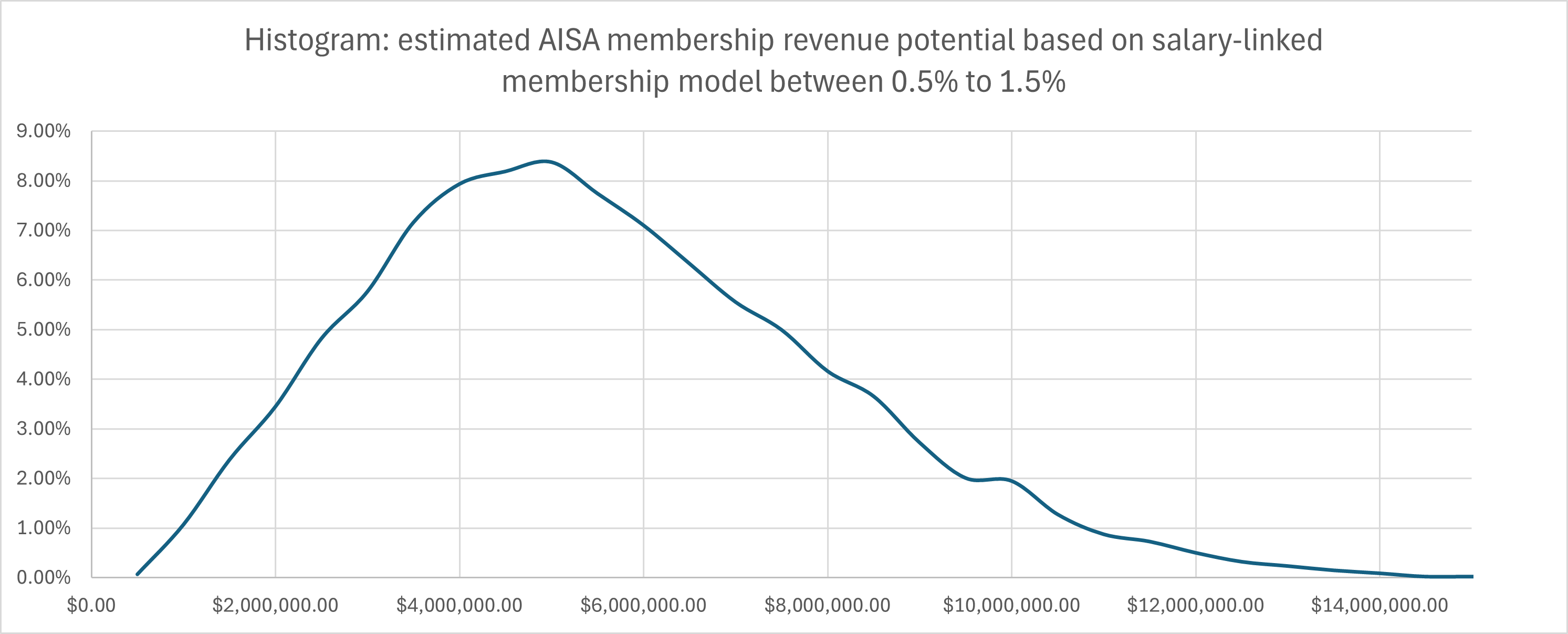
Using 15,000 Monte Carlo simulations, the model estimates that the AISA membership is worth over AUD 3,000,000 in 87.99% of simulations. (6)
The average simulation for the AISA membership generates approximately AUD 5.33 million in annual recurring revenue, with 6,789 members contributing around 1% of salary. (6)
In 93.91% of simulations, the average fee per member falls between AUD 600 and AUD 1,100 depending on the number of AISA members that can be converted over to a new membership fee structure and the fee-to-income ratio selected. (6)
This represents an increase of approximately 17x to 31x over current average membership revenue of AUD 35.
Scenario Modelling
The figure below compares three professionalization scenarios assuming 7,000 paying members, or roughly half of AISA’s reported membership base. In every case, projected revenue exceeds AISA’s current membership revenue. Scenario 2 produces roughly five times the current level. Scenario 3 produces roughly ten times the current level.
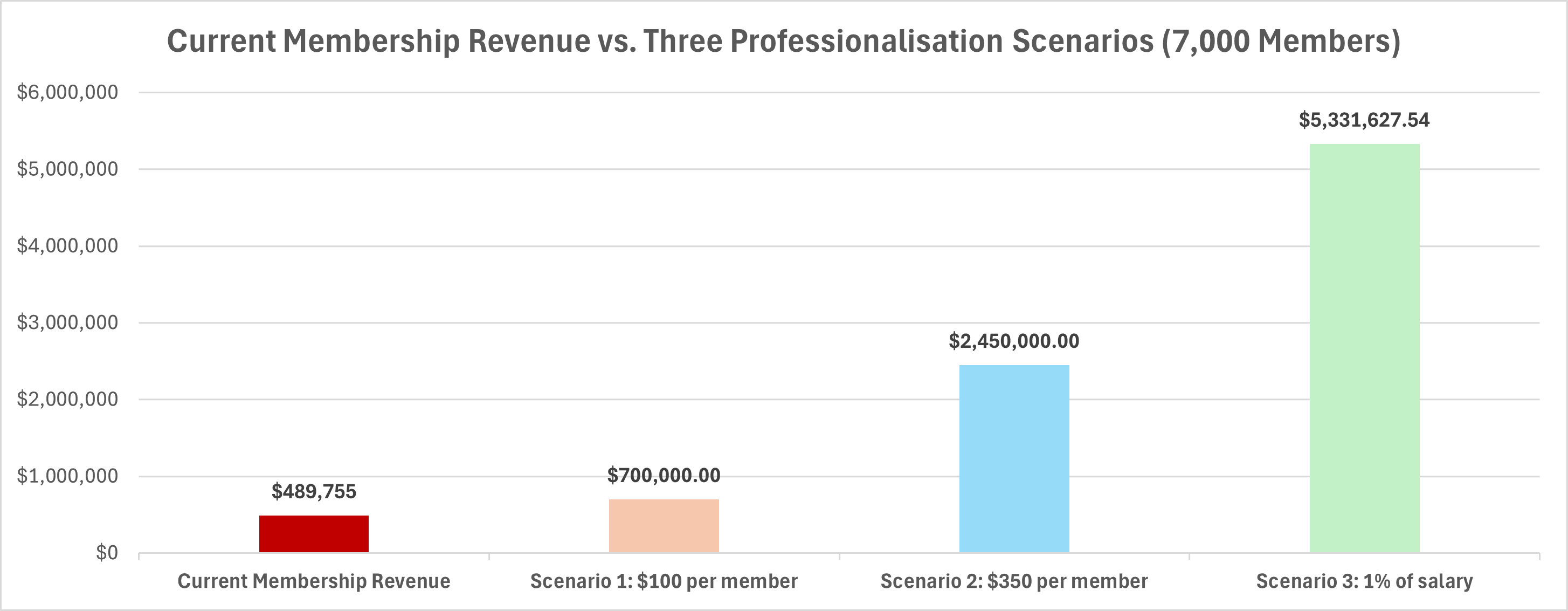
Scenario 3 would present the strongest financial incentive despite the risk of lower participation. From a revenue perspective, 7,000 members generating AUD 5.3 million is far more valuable than 14,000 members generating AUD 489,755.
A cautious pathway would be to phase fees in gradually - for example, beginning at 0.25% of salary and rising toward 1% over several years - so that the new revenue logic is introduced progressively rather than all at once.
Conclusion
The numbers suggest that professionalization is not just a standards project. It is also an economic restructuring of the profession. Under AISA’s current model, each member generates only modest membership revenue. Under a professionalized, salary-linked model, that same member could become a much larger recurring source of income.
That shift matters because once membership is tied to accreditation, governance, enforcement, and fee optimization, the member is no longer just part of a professional community. They are also part of a revenue structure.
The real question for AISA members is this: who benefits most from this structural change - members, or the institutions behind it?
References
-
AISA Website Homepage, Australian Information Security Association, 2025
-
AISA Financial Statements - 30 June 2025, Australian Information Security Association, June 2025
-
The Time for Professional Standards for the Australian Cyber Security Workforce is Now, Tony Vizza, March 2026
-
What Would a Credible Cybersecurity Professionalization Body Cost?, Benjamin Mosse, March 2026
-
Financing Cybersecurity Professionalization: A Monte Carlo Analysis of Salary-Linked Membership Models, Benjamin Mosse, April 2026
-
Excel Monte Carlo Simulation, Benjamin Mosse, April 2026