
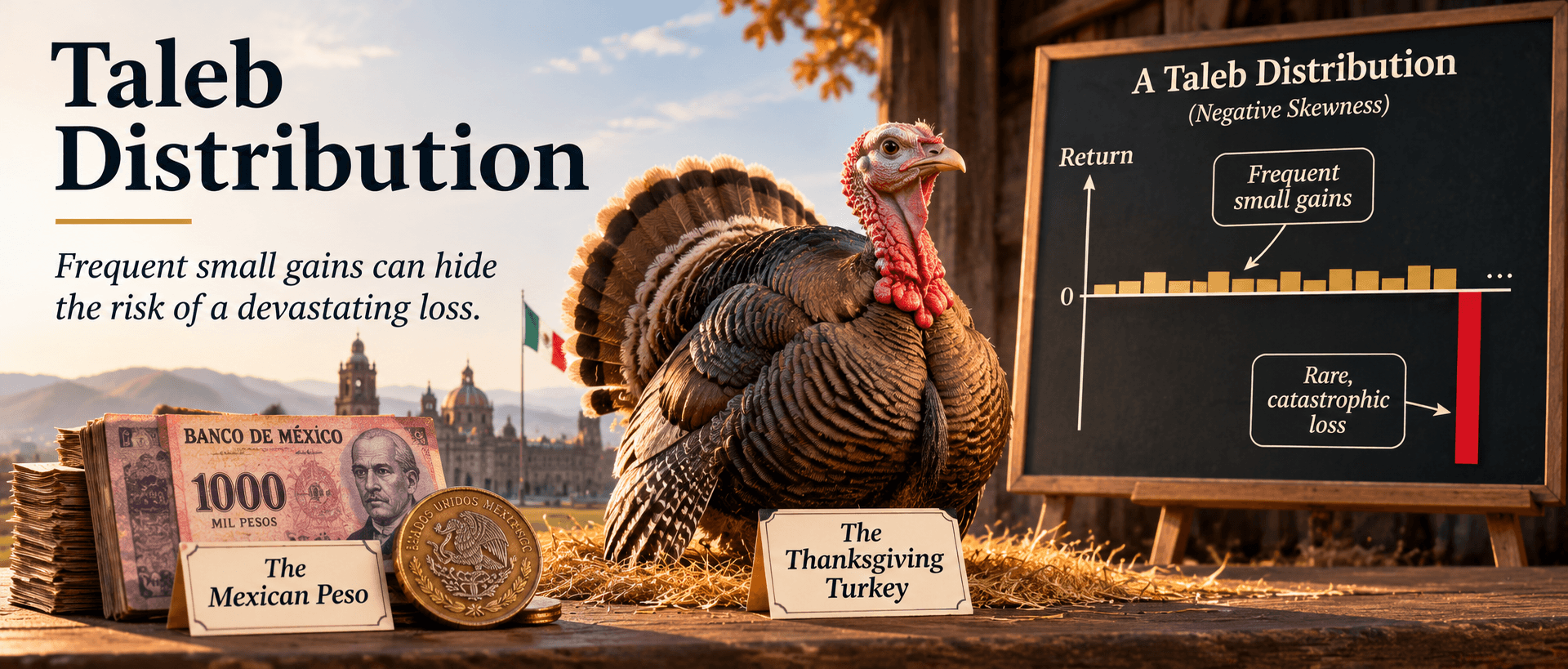
Frequent small gains can hide the risk of a devastating loss.
A strategy can make money almost every day, produce impressive returns for years, and appear remarkably safe.
Then one event wipes out everything it has earned.
This pattern is called a Taleb distribution, a term introduced by economist John Kay in 2003, based on Nassim Nicholas Taleb’s Fooled by Randomness. [1][2]
The Power of the Taleb Distribution
John Kay describes it as a situation where:
“many small profits are mixed with occasional large losses.” [1]
It describes a negatively skewed payoff pattern: frequent modest gains with the possibility of rare, enormous losses.
Winning frequently is not the same as making money over time.
A strategy can succeed 99% of the time and still be disastrous if the remaining 1% produces losses greater than all previous gains.
Taleb illustrates this danger through the Mexican peso problem.
For long periods, the Mexican peso appeared stable. Investors collected attractive interest rates by holding the currency. The steady income made the strategy look profitable and relatively safe.
Then came sudden currency collapses that destroyed accumulated gains.
Taleb describes how new generations of traders repeatedly returned to the peso after periods of stability, forgetting earlier disasters. [2]
Why This Matters
Taleb develops a related lesson through his famous Thanksgiving turkey, discussed in The Black Swan. [3]
A turkey is fed every day by a butcher. Each meal reinforces the turkey’s belief that the butcher cares for it.
After 1,000 days, the evidence seems overwhelming: life is safe, predictable, and improving.
Then comes Thanksgiving.
The turkey’s greatest confidence arrives just before its greatest disaster.
For the turkey, the event is an unexpected catastrophe. For the butcher, it was part of the plan.
A long history without losses is not proof that catastrophic losses are impossible.
The Mexican peso trader and the turkey share the same problem: they mistake repeated favourable experiences for evidence that the future is safe.
This also creates dangerous incentives. A fund manager may collect bonuses during years of steady profits while investors ultimately bear the catastrophic loss.
Not every negatively skewed strategy is unprofitable. Its value depends on the probability and size of its outcomes. The difficulty is that rare losses may be poorly represented in historical data.
The Practical Principle
When evaluating a strategy or decision:
- Examine the downside. Could one event erase years of accumulated gains?
- Look beyond win rates. Consider the size of gains and losses, not just their frequency.
- Question apparent stability. Could the greatest risk simply be missing from the historical record?
- Examine incentives. Who receives the profits, and who bears the catastrophic losses?
- Avoid ruin. Never depend on a strategy whose failure could permanently destroy your ability to continue.
The greatest danger may not be the losses you have experienced, but the losses you have never experienced—and therefore stopped expecting.
References
[1] Kay, J. (2003). “A Strategy for Hedge Funds and Dangerous Drivers.” Financial Times, January 16. https://www.johnkay.com/a-strategy-for-hedge-funds-and-dangerous-drivers/
[2] Taleb, N. N. (2001; revised 2004). Fooled by Randomness: The Hidden Role of Chance in Life and in the Markets. Chapter 6, “Skewness and Asymmetry.” Random House.
[3] Taleb, N. N. (2007). The Black Swan: The Impact of the Highly Improbable. Random House.
[4] Taleb, N. N. (2004). “Bleed or Blowup? Why Do We Prefer Asymmetric Payoffs?” Journal of Behavioral Finance, 5(1), 2–7. https://doi.org/10.1207/s15427579jpfm0501_1