
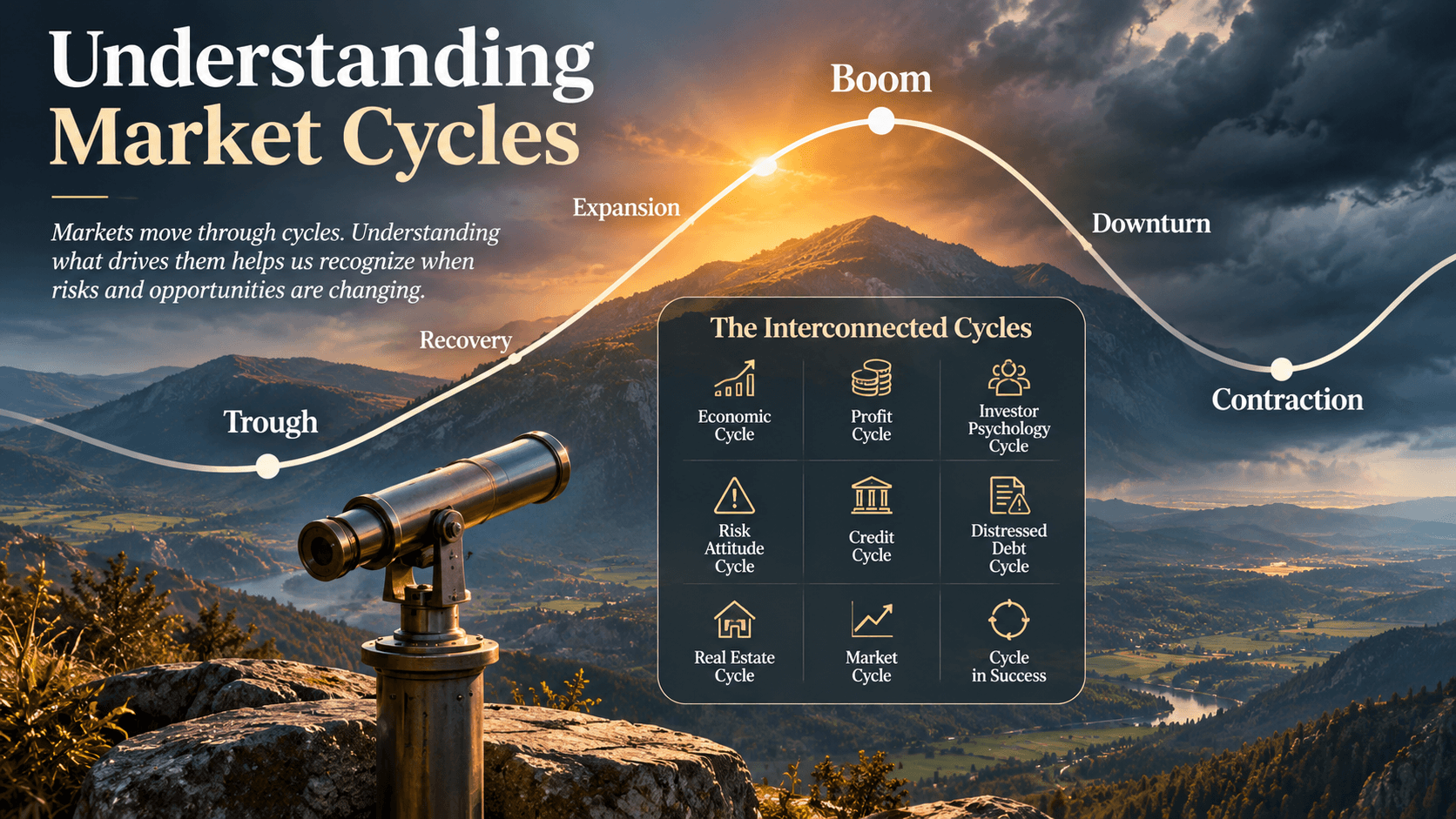
Markets move through cycles. Understanding what drives them helps us recognize when risks and opportunities are changing.
Markets do not move steadily upward.
Economies expand and contract. Profits rise and fall. Investors move between optimism and fear. Credit becomes easier to obtain, then harder.
These changes influence investment prices and the risks of buying at any given time.
Understanding cycles helps us judge when the odds are in our favor—and when they are against us.
The Power of Understanding Cycles
In Mastering the Market Cycle, Howard Marks explains:
“The odds change as our position in the cycles changes.” [1]
Marks argues that cycles are more than repeating patterns.
What happens at one stage of a cycle helps cause what happens next.
Prosperity encourages confidence. Confidence encourages risk-taking and lending. Easy credit pushes investment and asset prices higher.
Eventually, excessive lending, high prices, and unrealistic expectations leave the system vulnerable.
When conditions disappoint, lenders retreat, investors become fearful, and falling prices can deepen the downturn.
The forces that create a boom can also create the conditions for its collapse.
The Cycles to Recognize
Marks examines nine important, interconnected cycles:
- The Economic Cycle: Changes in economic growth, spending, employment, and investment.
- The Profit Cycle: Changes in corporate earnings, often amplified by fixed costs and debt.
- The Investor Psychology Cycle: Swings between optimism and pessimism, greed and fear.
- The Risk Attitude Cycle: Changes in investors’ willingness to accept risk.
- The Credit Cycle: Changes in the availability, cost, and conditions of borrowing.
- The Distressed Debt Cycle: Changes in defaults, financial distress, and opportunities to purchase troubled debt.
- The Real Estate Cycle: Changes in property demand, construction, supply, and prices.
- The Market Cycle: Rising and falling asset prices produced by the interaction of fundamentals, psychology, and financing.
- The Cycle in Success: How success attracts competition and capital, eventually reducing future opportunities.
Why This Matters
These cycles do not operate independently.
Economic weakness can reduce profits, increase defaults, frighten lenders, restrict credit, and push asset prices lower.
Falling prices can then create attractive opportunities for investors prepared to act.
The reverse occurs during periods of optimism.
Good conditions can encourage dangerous behavior, while bad conditions can create attractive investment prices.
Marks does not claim that cycles follow a fixed schedule or that their turning points can be predicted reliably.
His argument is about probabilities.
Knowing where we stand helps us decide whether to become more aggressive or more defensive.
The Practical Principle
- Study the cycles. Understand what drives each one and how they interact.
- Identify current conditions. Examine profits, valuations, investor behavior, lending standards, and credit availability.
- Look for extremes. Recognize excessive optimism, risk-taking, pessimism, or fear.
- Assess the odds. Consider how current conditions affect future returns and potential losses.
- Adjust your position. Become more cautious when risks are high and more willing to act when opportunities improve.
Cycle awareness cannot eliminate uncertainty.
But it can prevent us from treating today’s conditions as permanent.
The fundamental insight is that investing successfully requires understanding not just what is happening, but how current conditions influence what is likely to happen next.
References
- Marks, H. (2018). Mastering the Market Cycle: Getting the Odds on Your Side. Houghton Mifflin Harcourt. Chapters I–III, IV–XII, XIV, XVI, and XVIII.
- Marks, H. (2019). Mastering the Market Cycle: A Conversation with Howard Marks. CFA Institute. Discussion of market positioning and the credit cycle.