
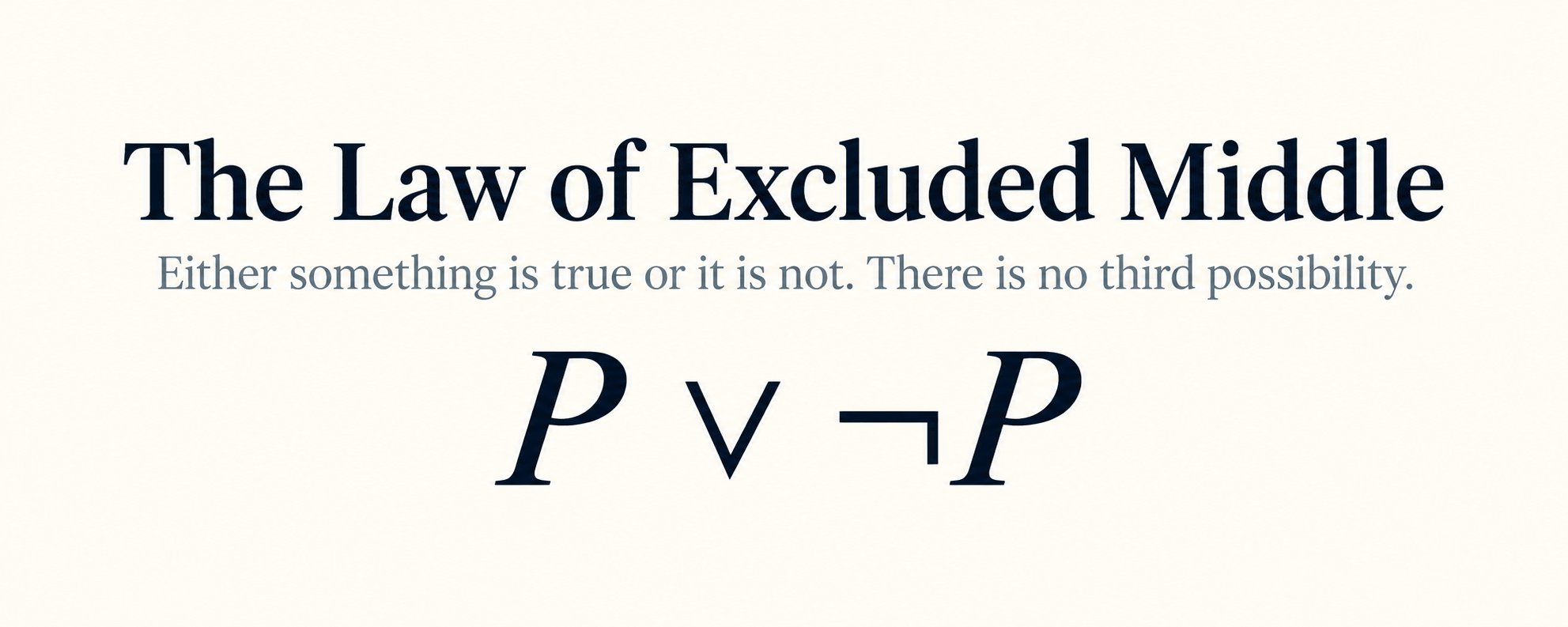
Either something is true or it is not. There is no third possibility.
The Law of Excluded Middle is one of the three classical laws of thought, alongside the Laws of Identity and Non-Contradiction.
Its central proposition is simple:
Either P is true, or P is not true.
In classical logic, there is no third possibility between a statement and its negation.
Aristotle expressed this in Metaphysics, Book IV:
“There cannot be an intermediate between contradictories.”
Why Excluded Middle Matters
The principle helps us distinguish between alternatives that cover every possibility and alternatives that do not.
Consider the difference:
- Black or white: Something can be neither. Other colors exist.
- Black or not black: These alternatives cover every possibility in classical logic.
The distinction is important because we frequently make decisions based on alternatives that appear exhaustive but are not.
We assume we must choose between A and B, without recognizing that C, D, or entirely different possibilities may exist.
Two alternatives do not necessarily cover every possibility. Only a proposition and its exact negation do.
This is the difference between a genuine logical distinction and a false dilemma.
Truth Is Not the Same as Knowledge
Another important implication is that our uncertainty does not necessarily change what is true.
A proposition can be true or false even when we do not know which.
Not knowing the answer does not mean there must be a third answer.
This distinction helps separate the state of reality from the limits of our knowledge.
The Practical Principle
When evaluating an argument or decision, ask:
- What is being claimed? Define the proposition clearly.
- What is its exact opposite? Identify its logical negation.
- Are these the only possibilities? Check whether other alternatives have been overlooked.
- Are we confusing uncertainty with reality? Distinguish what we know from what is actually true.
The Law of Excluded Middle does not mean every problem has only two solutions. It means that, within classical logic, a proposition and its negation exhaust the possibilities.
Other logical systems do not universally accept this law.
The fundamental lesson is to distinguish between genuinely exhaustive alternatives and choices that merely appear exhaustive.
References
- Aristotle. Metaphysics, Book IV, Chapter 7.
- Stanford Encyclopedia of Philosophy. Contradiction.
- Stanford Encyclopedia of Philosophy. Disjunction.