
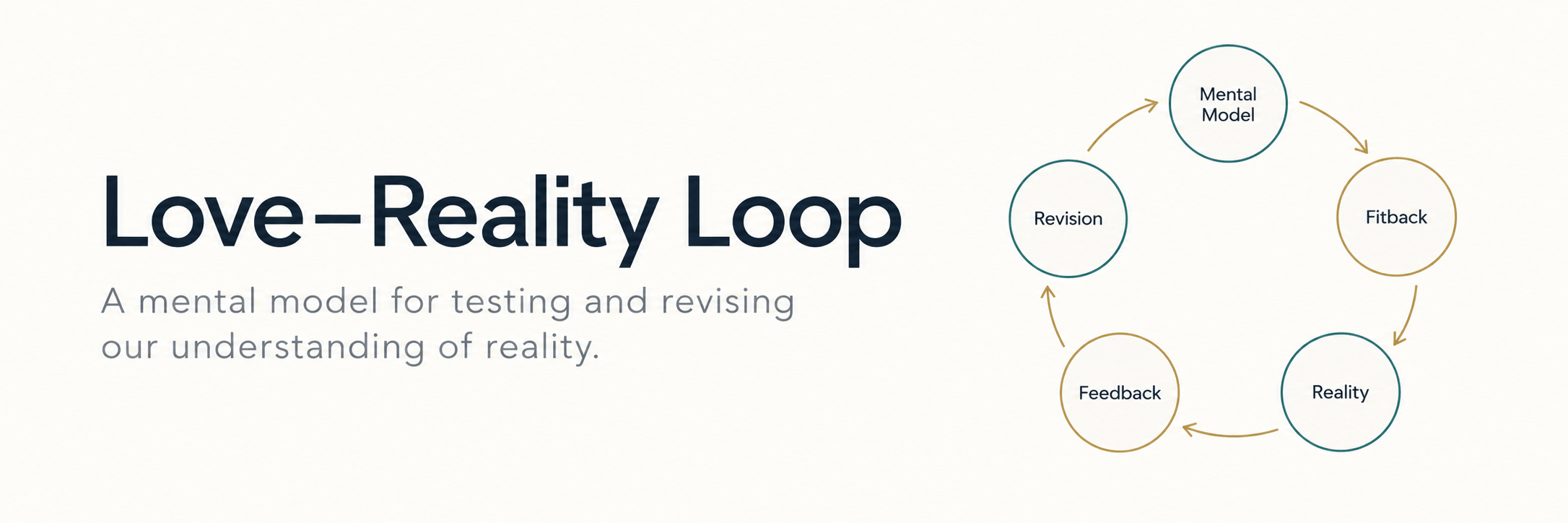
The Love–Reality Loop (LRL) is a theoretical framework developed by Derek and Laura Cabrera within DSRP Theory. It describes how mental models can become more accurate through continuous testing, feedback, and revision.
Its central premise is that our mental models are not reality itself. They are representations of reality, constructed from the information available to us and the way we organize that information.
Because information is incomplete and our interpretations can be mistaken, there will always be discrepancies between our understanding and the reality we attempt to explain.
The LRL describes a process for identifying and reducing these discrepancies.
As the DSRP research synthesis explains:
“A model fails because it is arranged differently from the thing it models, and the failure is the signal.”
This distinction matters because improving our thinking requires more than acquiring additional information. It can also require changing how that information is organized.
DSRP Theory identifies four patterns that structure mental models:
- Distinctions: What we identify as important and what we exclude.
- Systems: How we organize parts into wholes.
- Relationships: How we identify connections and interactions.
- Perspectives: How different viewpoints shape our understanding.
The LRL provides a framework for evaluating and revising these structures against evidence.
It operates through two complementary processes:
Fitback is the process of testing a mental model against reality through observation, prediction, experimentation, or action.
Feedback is the information obtained from those tests that reveals where the model succeeds, fails, or needs revision.
The DSRP research synthesis states:
“A model never tested cannot be corrected, and a model that cannot be corrected is only defended.”
This highlights the importance of corrigibility: the capacity to revise beliefs, assumptions, and conceptual structures when confronted with contradictory evidence.
In their 2025 paper, The Structure of Thought and Reality, Cabrera and Cabrera propose that both the information contained in a model and its organization influence how well it represents reality. They also propose that repeated testing and correction can improve alignment between mental models and the systems they represent.
These propositions are consistent with broader scientific principles of hypothesis testing, error correction, and iterative learning. However, the LRL’s proposed universal laws have not been independently established as general scientific laws.
The significance of the LRL is its emphasis on structural correction rather than simply accumulating information. An inaccurate mental model may remain inaccurate even as more information is added, if its underlying distinctions, relationships, boundaries, or perspectives are not reconsidered.
The practical value of the framework is straightforward: mental models should be treated as provisional explanations that must remain open to testing and revision.
The quality of our thinking depends not only on what we know, but on how effectively we detect and correct what we misunderstand.
References:
-
Cabrera, D., & Cabrera, L. (2025). The Structure of Thought and Reality: Empirical Evidence for the Three Universal Laws Linking Mind, Matter, and Meaning. Journal of Systems Thinking. https://doi.org/10.54120/jost.v25i1.dc6smio6
-
Cabrera, D., & Cabrera, L. (2026). Love Is a Behavior, Not a Feeling: A Testable Theory of Love as a Reality Alignment Process. Journal of Systems Thinking. https://doi.org/10.54120/jost.v26i1.dc6lbnf6
-
Cabrera Lab. DSRP Evidence: Love–Reality Loop. https://evidence.cabreralab.science/