In the first post, I focused on the practical benefits of DSRP Theory and why it has had a meaningful impact on how I think. In this second post, I step back and examine a deeper question: why does DSRP work so broadly across domains?
To answer that, I look at the internal logic of the theory itself.
In particular, I explore the structural dynamics of DSRP, the Love–Reality Loop, and the stronger universality claims made by Derek and Laura Cabrera - culminating in O-Theory.
This post explains why DSRP appears to apply almost everywhere, and how that universality motivates the broader claims the Cabreras develop in their research program.
Why is learning the Six Mental Moves - and DSRP Theory more broadly - so effective?
1. The Logic of DSRP Theory
First, we need to look at a study titled A Mathematical Theory of Organization.
In this work, Derek Cabrera presents a table that explains DSRP Structure and Dynamics. The table shows two key ideas: co-implication and simultaneity - how the elements imply one another and operate at the same time.
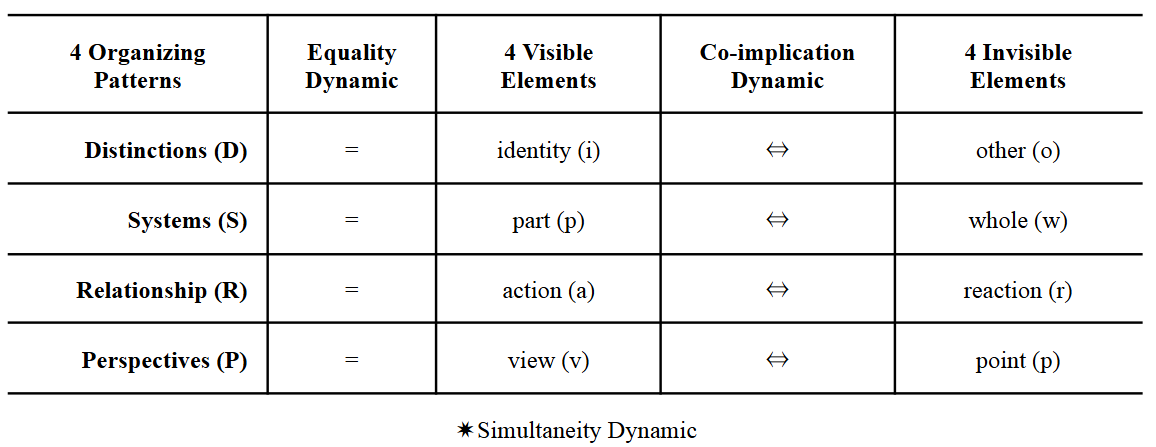
Cabrera argues this structure enables structural predictions, and the broader research program tests whether DSRP awareness improves performance on specific tasks.
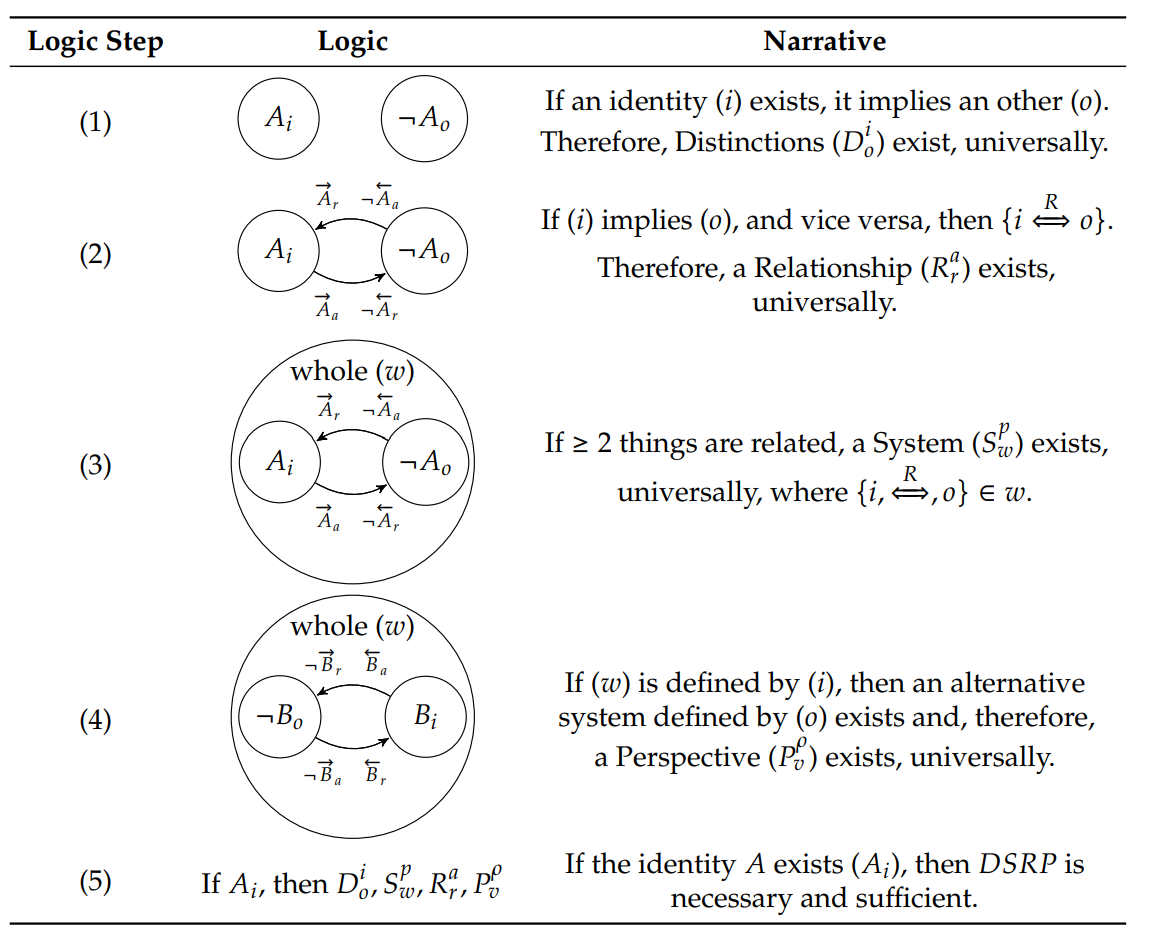
Here ‘structural predictions’ means: if you can identify one operator (e.g., a distinction), you can anticipate the presence of the others (boundaries, part-whole structure, relations, and a point–view frame), even if implicit.
Each pattern is equally important. On DSRP’s account, models become less complete and more brittle when any operator is ignored. For complex modeling tasks, DSRP treats all four patterns as jointly necessary for robust structure.
DSRP argues that omitting any one of the four patterns makes models more brittle - less complete, less coherent, and more prone to blind spots.
Co-implication (⇔) means each element comes with its counterpart: identity implies other, part implies whole, action implies reaction, and point implies view.
Simultaneity (✷) adds that any element can be interpreted through the other seven elements at once (even if we don’t consciously track every path in the moment).
Here’s DSRP’s logic in practice: (4)
With that, the Cabreras make two distinct claims about DSRP’s universality:
- Universality-as-grammar: DSRP as a minimal set of patterns for organizing information.
- Universality-as-reality: the stronger claim that reality itself is organized by DSRP.
2. The Love-Reality Loop
Next, we need to understand a core idea in DSRP Theory called the ST/DSRP Loop in earlier work, and later formalized as the Love–Reality Loop (LRL). (2, 4)
The Love–Reality Loop describes how models improve: we form a mental model, act on it, and reality pushes back with feedback.
If we “love reality,” we let that feedback correct the model rather than forcing reality to fit our preferences.
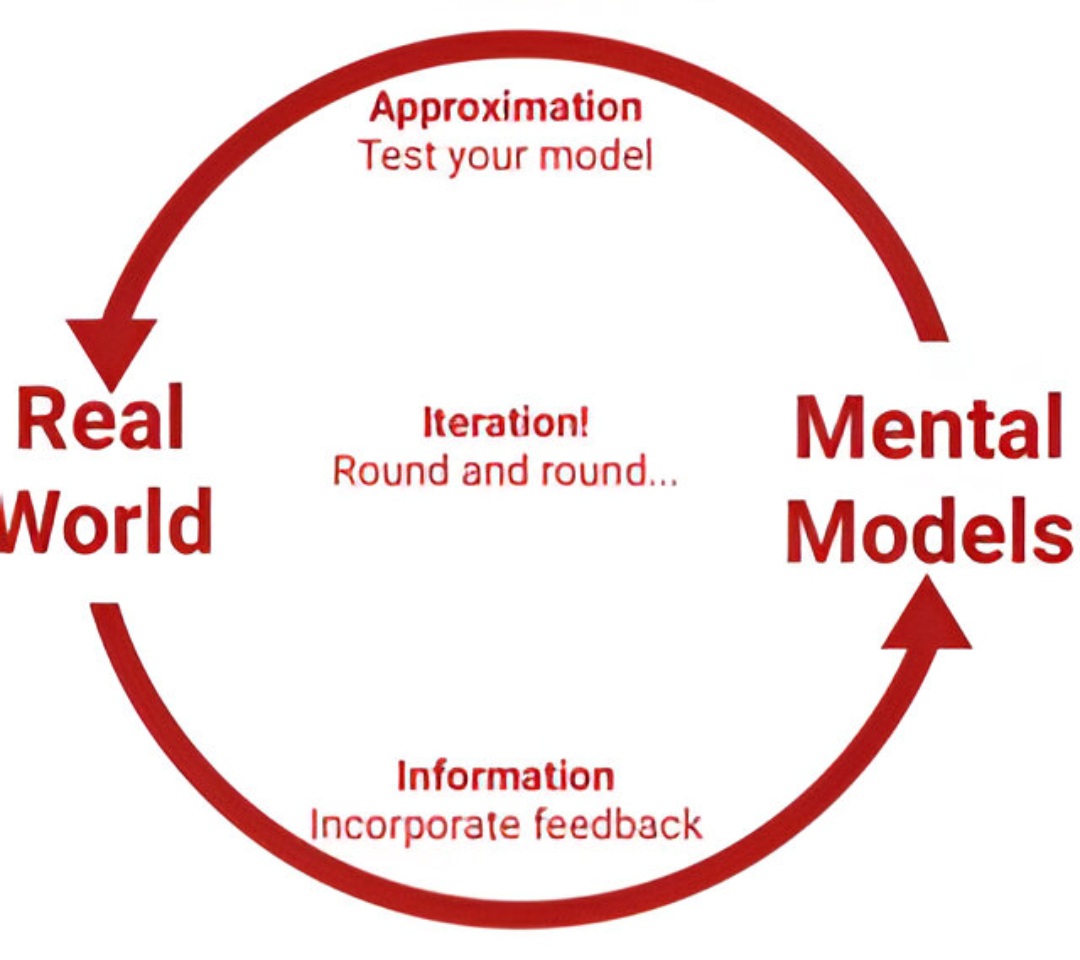
We update our mental models when we find better explanations or new evidence. Acting on these models tests them against reality, whose feedback provides the criticism needed to improve our explanations: approximation → test → incorporate feedback → iteration.
DSRP Theory provides a disciplined way to build stronger mental models from the outset. It does this by forcing attention to all four co-implied patterns of thinking - Distinctions, Systems, Relationships, and Perspectives.
By deliberately accounting for each pattern, a systems thinker constructs models that reflect the structure of the whole system, rather than a partial or fragmented view.
The result is a mental model that is more complete, more coherent, and intended to improve model–world fit (and can be evaluated with task-specific measures).
3. Wide Applications of DSRP Theory
Taken together, several parts of DSRP Theory make it an effective and practical tool for improving how we think and understand reality.
-
The Love–Reality Loop encourages us to map our mental models, test them against reality, and continuously update them.
-
Knowing that DSRP elements are co-implicated and simultaneous means when we notice one D/S/R/P pattern in our description of something, DSRP’s rules prompt us to generate the missing structural predictions (the other patterns/elements).
In one paper, Derek and Laura Cabrera describe DSRP as “a different kind of theory of everything”. (1)
Their argument is compelling:
“A ToE (Theory of Everything) should not only apply to everything, it should also be useful to everyone. A quilter, a skateboard, a physicist, a chemist, biologist, cognitive scientist, psychologist, sociologist, computer scientist, economist, geologist, astronomer, and to business leaders and policy wonks, auto-mechanics and quantum mechanics should all find a ToE equally useful to their trade.
It must bridge both the material-physical domains as well as the material-conceptual domains. It should therefore be not only a theory of physical things but also a theory of information, concepts, ideas. It should be a theory that bridges theory and practice and is used by all to understand and do all things. Because, after all, everything should mean, everything.” (1)
DSRP largely fits this definition. It has a growing empirical literature, including both universality-oriented work and applied studies on whether DSRP instruction/awareness improves performance on specific tasks.
4. O-Theory as the Grammar of reality
In a 2025 paper, Derek and Laura Cabrera introduce O-Theory. (2) This theory aims to unify epistemology (how we know) and ontology (how reality is) through a shared law of organization.
The core claim is that reality organizes itself using the same patterns as human cognition. On this basis, they propose a more precise version of the Love–Reality Loop:
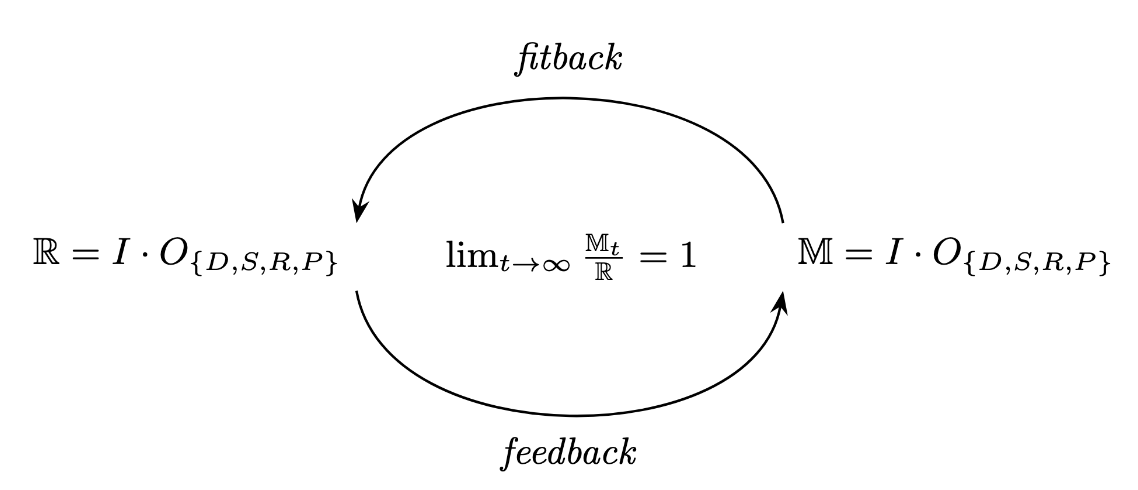
Notice that the structure on the left mirrors the structure on the right.
Reality (R) provides feedback to our mental models. In response, our Mental Models (M) update themselves - what the authors call fitback - to better align with reality.
The deeper claim is the ontological extension developed in O-Theory: that DSRP does not only describe how we think, but also how reality itself is organized. (2)
Conclusion
On the Cabreras’ terms, DSRP is “universal” because it describes a minimal grammar of organization: the four patterns (Distinctions, Systems, Relationships, Perspectives) and their co-implicated, simultaneous dynamics. (4)
That universality has two closely related aspects:
-
Universality-as-grammar: DSRP as the minimal set of structural operators by which information can be organized into coherent identities and models.
-
Universality-as-reality: the stronger, epi-ontic framing developed in O-Theory (bridging epistemology and ontology), where the same organizational grammar is argued to hold in both mind (mental models) and nature (reality’s organization). (2)
The Love–Reality Loop then provides the learning dynamic: models improve through iterative alignment—model → action → feedback → revision—while DSRP provides a disciplined way to build and stress-test the structure of those models (what is distinguished, what is included/excluded, how parts relate, and from which perspectives the system is being framed). (2, 4)
In the final post of this series, I map the boundaries and handoffs implied by the structural-grammar framing: what DSRP constrains (structural coherence), what it leaves open (multiple coherent framings and representations), and where domain theory, measurement, and empirical comparison necessarily take over.
In other words: Part 2 explains the universality logic; Part 3 explains how to apply that logic rigorously - by being explicit about the handoffs between structural grammar and domain content.
References
-
Any Person, Any Study : A Different Kind of Theory of Everything (ToE), October 2023, Derek Cabrera; Laura Cabrera
-
O-Theory : The Science of Organization, November 2025, Derek Cabrera; Laura Cabrera
-
A Mathematical Theory of Organization : DSRP as Universal Code of Mind and Nature for Organizing, Evolving, and Understanding Information, July 2024, Derek Cabrera
-
DSRP Theory: A Primer, March 2022, Derek Cabrera; Laura Cabrera
Thank you for reading. If any errors or misunderstandings appear in this article, they are entirely my own and should not be attributed to Derek and Laura Cabrera or their work.